
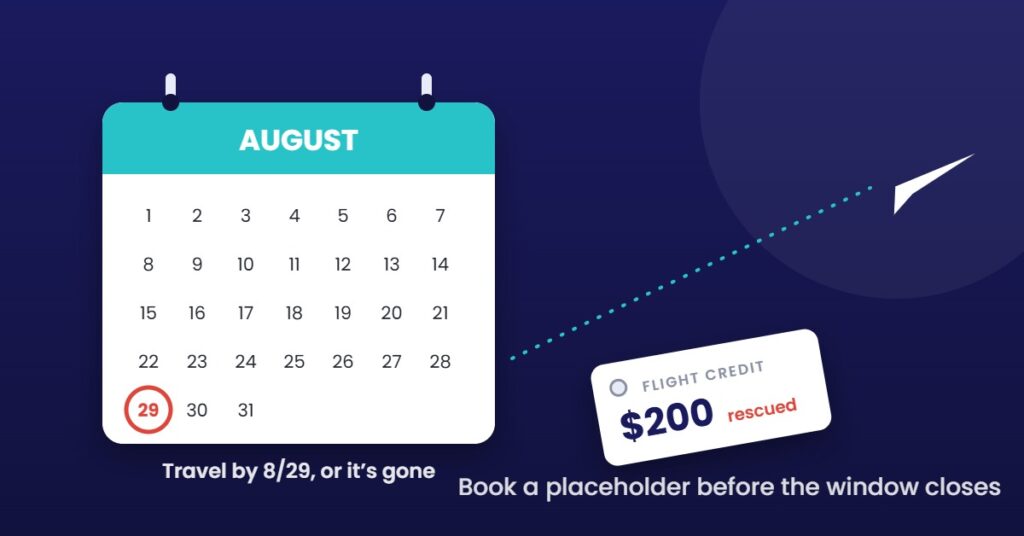
If you follow our supercommuting playbook, you end up holding a wallet of United flight credits at any given time. That’s by design — credits are how you bank cheap fares and redeploy them. But United’s credit system has rules that are documented nowhere prominently, and one of them quietly shortens the life of your money. We learned these rules the expensive way, at the checkout screen. This article covers how United flight credits really behave: the expiration inheritance rule, the per-traveler wall, and a rescue technique we call the placeholder swap — plus the triage math for when a small credit isn’t worth saving.
How United Flight Credits Actually Work
United issues two different instruments, and they don’t mix. A future flight credit (FFC) is what you get when you cancel or change a non-refundable ticket. A travel certificate (ETC) is compensation — for bumps, service failures, and the like. At checkout you can combine multiple flight credits, or multiple certificates, but never both on one purchase; United’s travel credits page covers the basics.
The deadlines work differently, too. A certificate has a book-by date — purchase by then and you can fly much later. A flight credit has a travel-by date: your trip must begin by that date. A flight credit that expires August 29 is useless for a December trip, no matter when you buy the ticket. (The Points Guy’s guide is a good general reference.)
Finally, flight credits are name-locked. A credit issued to a traveler can only pay for a ticket for that same traveler. Keep that in mind — it matters more than you’d think.
The Expiration Inheritance Trap
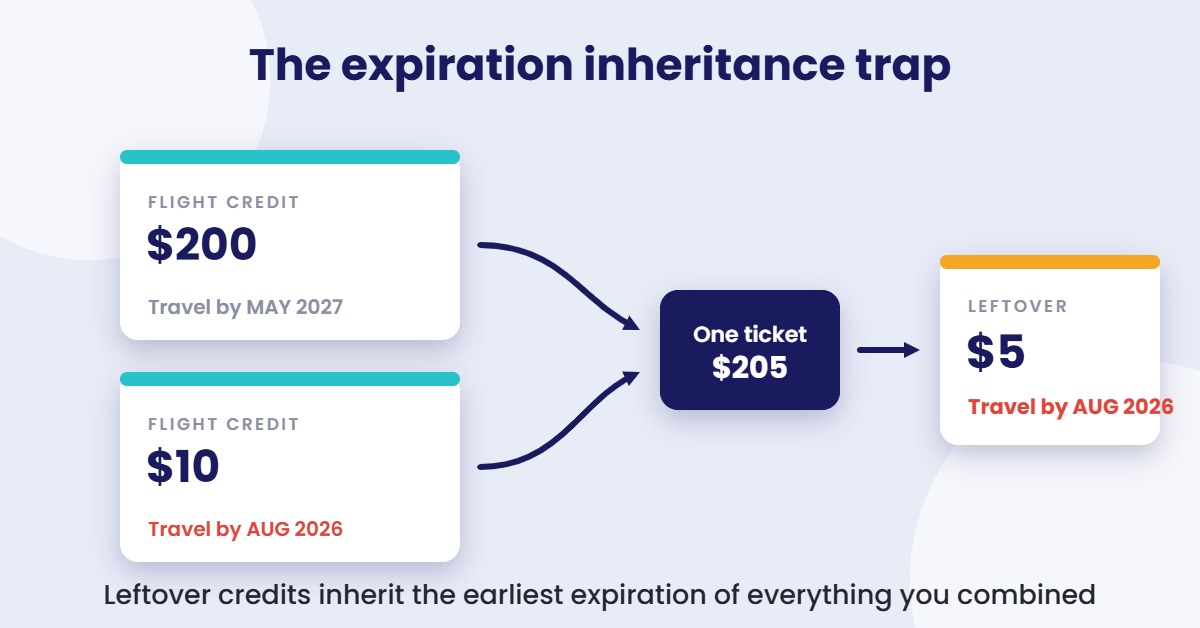
Here’s the rule that costs people money. When you combine several credits on one purchase and the purchase doesn’t consume them exactly, United issues a new credit for the leftover. That new credit doesn’t keep the expiration date of the credit it came from. In United’s own checkout language:
“When future flight credits are given for any residual value, the new credit will adopt the earliest travel-by date of all the credits for that traveler.”
Read that again: the earliest date. Combine a credit expiring next month with one expiring next year, and any leftover — even one dollar of it — inherits the next-month deadline. Do this a few times and you can accumulate a series of credits with shorter-than-expected lives, even though most of the money started out with plenty of runway.
The trap bites hardest when your near-term travel is already booked. A credit with a tight travel-by date is only useful if you need to start a trip before that date — and if you don’t, the money evaporates on schedule.
The defensive rule: before you hit purchase, look at the travel-by date on every credit you’ve checked. If one of them is much earlier than the rest, ask whether the leftover you’re about to create can live with that date. If not, uncheck the short-dated credit and let it fight its own battle.
Credits Don’t Pool Across Travelers
Booking for two people with a pile of credits? The checkout math is not what you’d expect. United doesn’t apply your combined credits against the combined total. It splits the fare per traveler and applies each person’s credits only against that person’s share.
Say the total is $400 for two travelers — $200 each (numbers rounded for clarity throughout). Traveler A has a $150 credit; traveler B has two $120 credits. You might expect the $390 in combined credits to nearly cover the $400 total. Instead, United covers traveler B’s $200 exactly (one full $120 credit plus $80 of the second, leaving a $40 residual in B’s name) — and traveler A still owes $50 that B’s leftover cannot touch. You either pay it in cash or apply another of A’s credits.
Two practical consequences:
- Plan credit usage per person, not per booking. A household’s credits are separate pots.
- Residuals are per person, too — and each residual inherits the earliest travel-by date among that traveler’s applied credits.
The Placeholder Swap: Rescuing a Credit Before It Expires
So you have a credit whose travel-by date arrives before you actually want to fly. United’s checkout will refuse to apply it to your real trip. Short of asking United to extend it (possible, but slow and uncertain), there’s a workaround: the placeholder swap.
The mechanics
First, find the flight you actually want — outside the credit’s window. Note its exact price. Then book a different flight that departs inside the credit’s window, paying with the expiring credit, at a price as close as possible to your target flight. Finally, change the placeholder booking to your target flight. United charges no change fees on standard domestic fares, so the change costs only the fare difference — and the original credit’s travel-by restriction doesn’t follow the ticket through the change.
Price the placeholder at or just below the target
This is the detail that makes or breaks the play. If the placeholder costs more than the target flight, the downgrade spits out a residual credit — which inherits your short expiration date, and you’re back where you started. If the placeholder costs the same or slightly less, the change is a small cash add-collect, and no residual is ever created. A $140 placeholder swapped into a $150 target means a $10 charge at change time and nothing left behind. The inheritance rule can’t bite if nothing is left over.
One warning from experience: fares inside a closing expiration window trend upward as the date approaches, so the earlier you run the swap, the easier it is to find a clean price match. And book regular economy — basic fares can’t be changed at all.
Triage: When to Let a Small Credit Go
Not every credit deserves a rescue mission. We nearly repeated our own mistake here: trying to fold a $10 credit (expiring in seven weeks) into a $400 two-traveler booking. The cheapest credit combination that included it came to $440 — meaning a $40 residual stranded at the seven-week deadline. That’s risking $40 to save $10, before counting the execution risk of running a placeholder swap on a two-passenger itinerary, where exact price matches are twice as hard to find.
The triage questions, in order:
- Can the credit apply directly to travel you already want? If yes, done — no games needed.
- If combined, what residual does it create, and what date does that residual inherit? Never endanger more money than you’re rescuing.
- Can it ride alone later? A small credit plus cash on a cheap single-traveler placeholder — priced at or under a target flight — rescues the money with zero residual risk. Small credits are patient; big deadlines are not.
- Is it simply too small to bother? A $1 credit is a souvenir. Let it go.
The underlying principle mirrors the rest of our supercommuting approach: every move should protect the larger pot first and optimize the small stuff second. Tracking a wallet of credits, placeholders, and travel-by dates is exactly the kind of moving-parts problem a visual planner exists for — the Anywhere Calendar can hold the whole picture in one view.
A Worked Example, Start to Finish
Here’s the full sequence from our own bookings, with the numbers rounded so the pattern is easy to follow.
The setup: a wallet of credits with travel-by dates ranging from six weeks to a year out, and a $150 October flight we wanted that sat outside the six-week credit’s window. We ran the placeholder swap — booked a three-weeks-out flight with the expiring credits, then immediately changed it to the October flight. The rescue worked. But we combined credits carelessly, and the small leftover inherited the six-week deadline: a stranded $10.
The next booking was the $400 December trip for two described above. The temptation was to stuff the $10 in and rescue it, too. The math said no: it would have stranded $40 at the same short deadline. Instead we covered each traveler’s $200 share from that traveler’s own credits — full coverage, zero cash — and accepted a $40 residual that inherits a comfortable date ten months out. The $10 waits for a cheap solo placeholder, paired with cash so no residual is possible.
Total spent out of pocket across both plays: $0. Total at risk at any point: never more than the smallest credit on the table. That’s the goal.
Put Credit Rules Into Your Anywhere Plan
United flight credits are powerful, but they follow rules the checkout page only whispers: residuals inherit the earliest expiration, credits never cross traveler lines, and travel-by dates bind the trip’s start, not the purchase. Check every credit’s date before you combine, price placeholders at or under your target, and let the tiny credits go when the math says so. Add these rules to your Anywhere Plan, and your banked fares will stay yours to spend.
Note — policies verified as of July 2026; airline rules change, so confirm current terms at united.com before relying on any single play.